


Table of Contents
Estimated read time: 24 mins
INTRODUCTION
If you work in warehousing or transport operations, you will likely have come across the term “load containment force”. It sits at the heart of what every pallet wrapping operation is trying to achieve, and yet in many warehouses, it’s never directly measured.
In this guide, we’ll explain what containment force is, how it’s measured, and how operations can achieve it consistently and efficiently.
WHAT IS LOAD CONTAINMENT FORCE?
Load containment force is the inward pressure that pallet wrap exerts on a load once it has been applied. Put simply, when stretch film is applied to the pallet, it generates a compressive force that holds the individual units of a load together, stabilising it during handling and transit.
It is useful to think of containment force as one of the functional outputs of a wrapping operation. The film is the tool, but containment force is the result that actually determines whether a load is stable. A pallet can appear well wrapped and still fall short under the tertiary forces it will experience on the road.
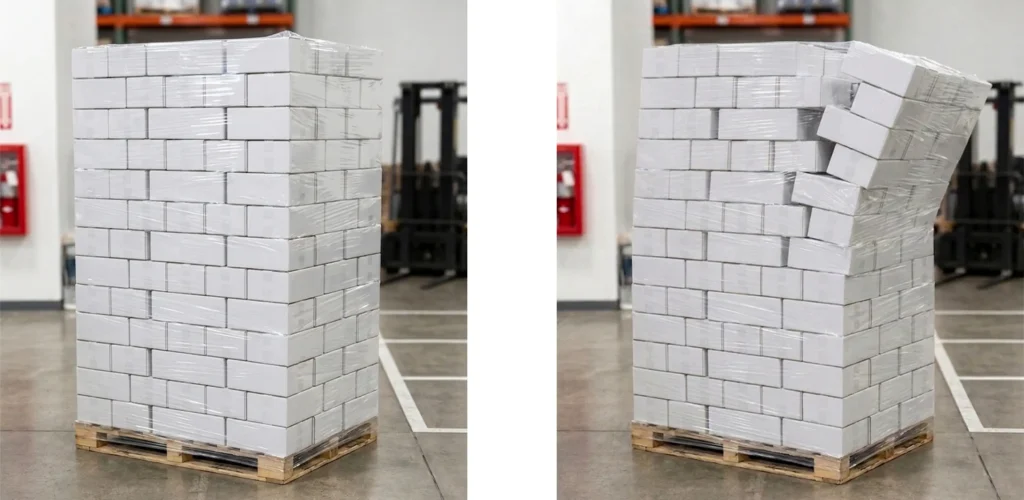
This distinction is not a technicality. A pallet that looks secure but lacks sufficient containment force may fail to meet the load stability standards required for safe road transport, such as Directive 2014/47/EU.
HOW IS LOAD CONTAINMENT FORCE MEASURED?
Containment force is not something you can assess by eye. Measuring it requires dedicated testing equipment, and the correct approach depends on:
- the load type;
- the information required;
- and the specific variables being investigated.
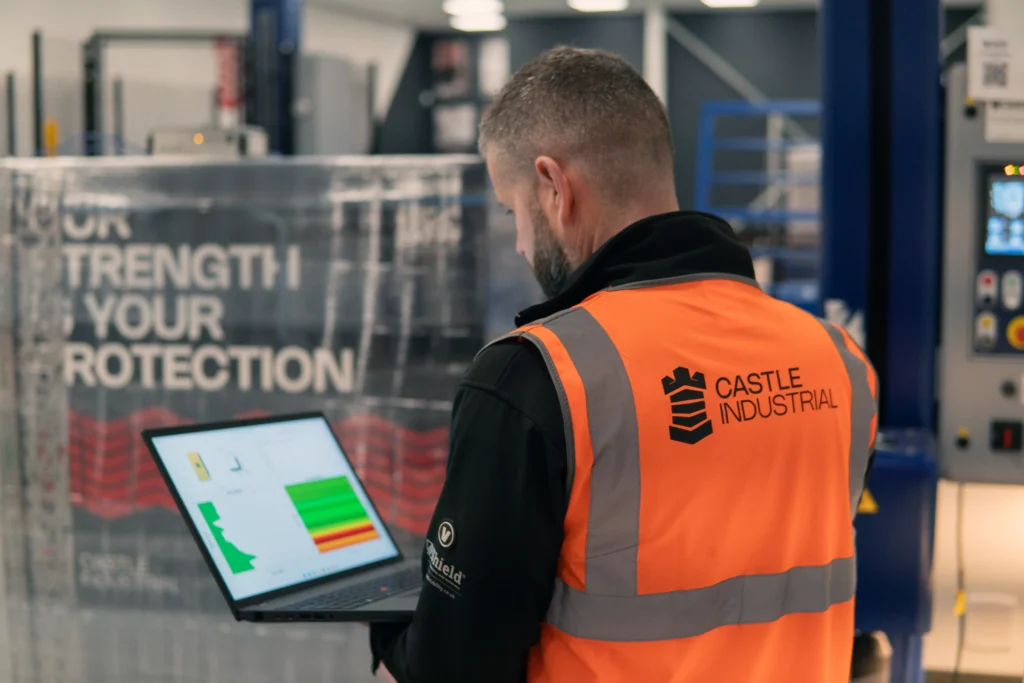
At Castle, our Load Stability Technicians use specialist tools to assess on-pallet film performance, measuring the forces generated by the film after wrapping, giving a precise, data-driven picture of how the wrapping operation is actually performing.
What is the unit of measurement for containment force?
Containment force can be measured in decanewtons (daN) or kilograms, where one decanewton is equal to 1.02kg of holding force. It is generated by the retraction in the film as it attempts to recover after being stretched during application.
MEASURING FILM EDGE FORCE: ESTL FEF-200
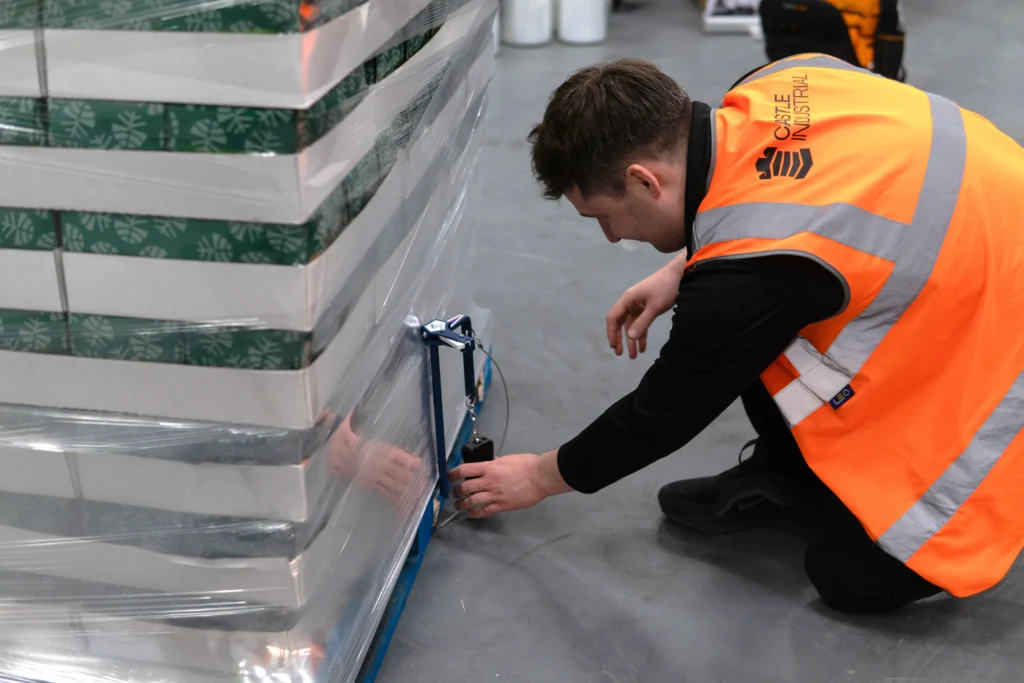
Castle’s technicians use the ESTL FEF-200, a portable Film Edge Force measurement system that can be mounted directly onto any pallet before wrapping begins.
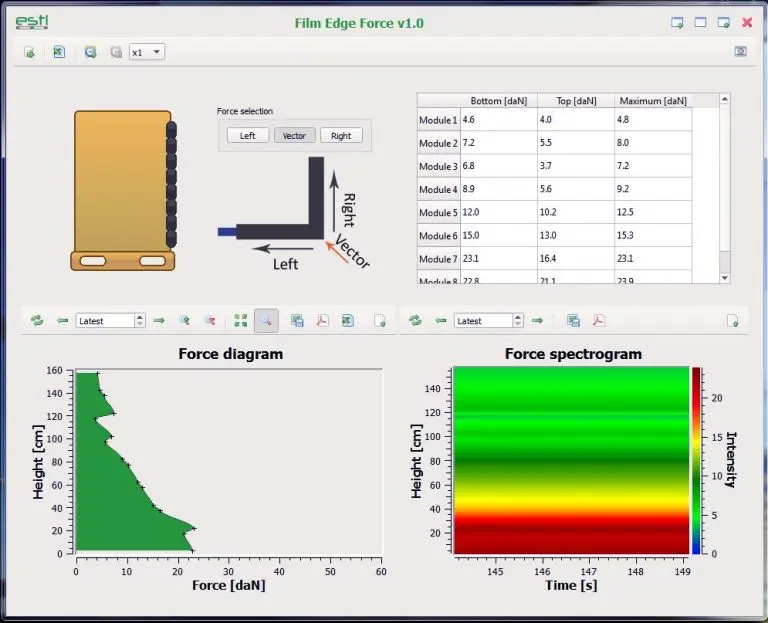
The FEF-200 consists of up to 10 load cells, each measuring the force generated by the film in three sections: across the left side, right side, and the vector (combined force pulling directly on the corner of the pallet).
A complete setup can capture data at up to 40 locations across the corners of a pallet, producing a precise picture of how the film is performing across the full height of the load.
Castle’s technicians use the ESTL FEF-200, a portable Film Edge Force measurement system that can be mounted directly onto any pallet before wrapping begins.
The FEF-200 consists of up to 10 load cells, each measuring the force generated by the film in three sections: across the left side, right side, and the vector (combined force pulling directly on the corner of the pallet).
A complete setup can capture data at up to 40 locations across the corners of a pallet, producing a precise picture of how the film is performing across the full height of the load.
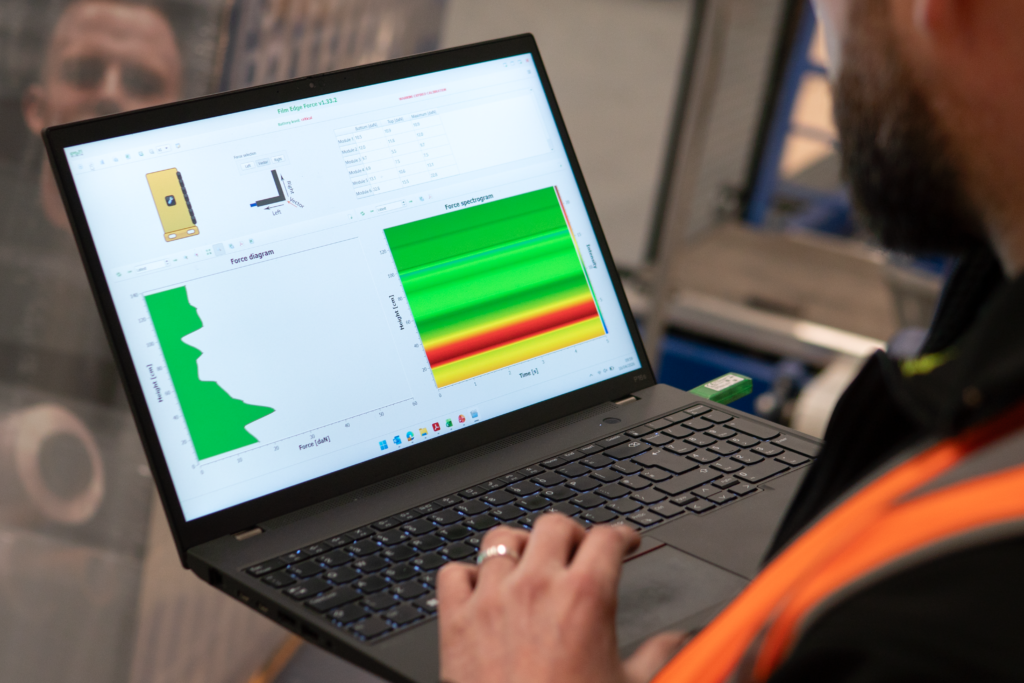
Once wrapping is complete, the FEF-200’s software generates a force profile mapped against pallet height. This reveals not just the overall force being applied, but where it’s concentrated, where it falls short, and whether the wrap pattern is producing consistent results from top to bottom.
MEASURING FACE CONTAINMENT FORCE: LANTECH CFT-6
Where the FEF-200 measures forces at the edges, the Lantech Containment Force Tool (CFT-6) measures the containment force acting on the flat faces of the pallet load. It’s used after wrapping, with a probe inserted into the film at three points on the load: top, middle, and bottom.
The readings at each point reveal how force is distributed across the individual points of the pallet, identifying where on the height of the pallet it is sufficient, where it falls short, and where it may even be excessive. This tool is compact, quick to set up, and suited to a wide range of load types, including loads where corner geometry makes edge force measurement impractical.
In practice, the choice of tool depends on the load and the specific assessment being carried out. There is no universal approach, which is itself a useful illustration of the broader principle at the heart of load containment: every operation is different, and the right answer is always determined by measurement and analysis, not assumption.
When you see the results for the first time, it changes how you think about wrapping. You stop asking ‘does this pallet look stable?’ and start asking ‘what does the data say?’ That shift is what leads to real, lasting improvements.
DAVID PROCTOR
LOAD STABILITY CONSULTANT
WHY IS CONTAINMENT FORCE IMPORTANT?
Without sufficient load containment, businesses run a real risk of product damage and financial loss. Research published by the European Commission indicates that up to 25% of truck accidents involving goods vehicles may be linked to poorly secured cargo.
Damaged Goods
Your pallets may look fine in the warehouse, but without proper containment they will inevitably fail on the road. In some operations, just one deformed pallet at the loading dock can lead to the entire truck being rejected.
Non-Compliance
Standards like EUMOS 40509 set out how load stability should be assessed. It requires unitised loads to withstand horizontal accelerations experienced during braking, cornering, and acceleration. For operations in the EU, failure to comply represents significant legal, safety, and financial risks.
Warehouse Inefficiency
Beyond compliance, the operational case is equally clear. Over-wrapped pallets consume film unnecessarily. Under-wrapped pallets create instability. Neither outcome is acceptable, and without measurement, it is very difficult to identify which problem you actually have.
Safety for Operators and Drivers
Failing pallets are more than a compliance concern, they can cause serious harm to warehouse operatives and drivers too. Whether pallets are collapsing out on the road, or failing in the warehouse before they even make it onto the truck, correct load containment is essential.
HOW MUCH CONTAINMENT FORCE DOES A PALLET NEED?
This is one of the most commonly asked questions in load containment, and the answer is that there is no single figure. EUMOS 40509 does not prescribe a universal value for containment force.
The correct level of containment force depends on what is being wrapped: the weight and dimensions of the load, its centre of gravity, the nature of the units being secured, and the film being used.
What this means in practice is that following a simple weight-to-force rule is not always reliable. For example, a heavy, unstable load with a high centre of gravity may require more containment force than a light, uniform load.
The best way to establish the right containment force for a specific load type is to measure it, and then to test the impact of any changes to film specification or machine settings against that measured baseline.
Containment Force Distribution
It is also worth noting that containment force should be distributed consistently across the height of the pallet, not simply achieved at a single point. A wrap pattern that concentrates force at the base but leaves the upper load poorly supported will not deliver genuine stability, even if the overall force reading appears adequate.
The reliable way to establish the correct containment force for a specific load type is to measure it under controlled conditions. Castle’s Test Centre in the UK enables operations to simulate real-world transit conditions, confirming the right film specification and wrapping technique before any changes are made on the warehouse floor.
HOW TO ACHIEVE LOAD CONTAINMENT FORCE
Getting containment force right comes down to many different interconnected variables. When Castle’s technicians conduct on-site wrapping operation reviews, they regularly encounter some common issues:
Under Stretching: Applying film below the optimal stretch zone can result in weak or reduced containment. When film is under stretched, the polymer chains aren’t fully aligned and maximum elastic energy hasn’t been stored.
Over Stretching: Just as you’re open to risk under stretching, you’re equally at risk over stretching the film too. Over stretching creates a weaker structure with a higher level of concentrated stress.
Over Tensioning: Applying more force than the load requires can deform or crush primary and secondary packaging. Stability is not significantly improved beyond the point at which adequate containment is achieved.
- Over Wrapping: Similarly, once sufficient containment force has been achieved, applying more film consumes extra material, making the process inefficient as a result.
- Wrapping Pattern: The number of wraps at the base and the overlap between layers all influence how containment force is distributed across the pallet height. The FEF-200 force profile makes these distribution issues visible in a way that visual inspection cannot.
CONTAINMENT FORCE TESTING AT CASTLE
If you are unsure whether your current wrapping operation is achieving the containment force your loads require, or you have already identified warning signs of load stability issues, the starting point is measurement.
Get in touch with Castle’s technical team to discuss an on-site wrapping operation review.
Achieving Load Containment Force

Written by
Guide to Pallet Wrapping Machines

Written by
What is Pre-Stretch Pallet Wrap?

Written by
Long-Term Pallet Wrap Storage: Expert Tips from the Warehouse

Written by
What Is Void Fill Packaging (and Does It Prevent Damage)?

Written by
What is The Safest Pallet Stacking Pattern

Written by
PPWR Regulation: How to Reduce Plastic and Maintain Load Stability

Written by
What is EPR? An Introduction to Extended Producer Responsibility

Written by
What is Stretch Film Memory?

Written by